
Remembering Madame Yucca This Women’s History Month by: Angela Marandola
Some women make history and then quietly vanish from it. Their stories fade, their names slip from the record, and over time, we forget just how many there were. In many cases, we never even knew their names at all.
One of the women whose story nearly disappeared is Mary Kumpf, better known on stage as Madame Yucca.
Search for her today, and you will find surprisingly little, just a few scattered references and the occasional passing mention. Yet in her time, Madame Yucca was a headline circus performer whose incredible strength made her a sensation wherever she performed. But her legacy reached far beyond spectacle. At a time when domestic abuse was rarely discussed publicly, she used her platform to speak about it openly, challenging the societal norms and gender stereotypes that shaped expectations within relationships.
In doing so, Madame Yucca transformed her stage presence into something more than entertainment. She used it as a platform, one that allowed her not only to demonstrate physical strength but also to question the assumptions about women and power that defined her era. Today, her name is largely absent from the historical record, but the impact of voices like hers helped lay the groundwork for conversations that continue today.
Content warning: mentions of physical, emotional abuse, and animal abuse.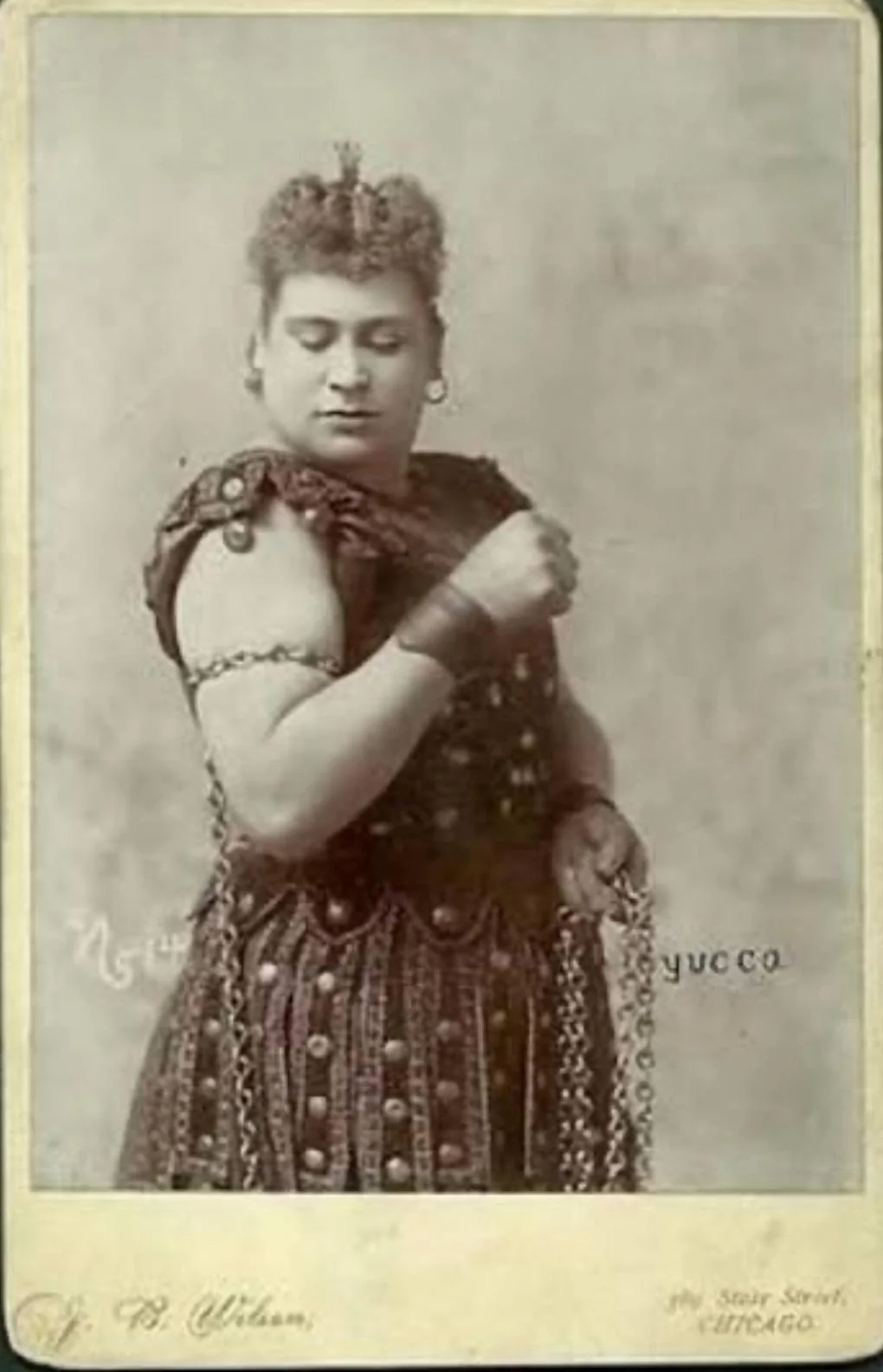
Mary grew up in San Francisco, working long hours doing laundry to support herself. In the 1890s, her life took a dramatic turn when she joined the Barnum & Bailey Circus. There, her extraordinary strength became its own performance, propelling her from humble beginnings into the center ring.
By the early 1900s, she had become a star performer with the Welsh Brothers Circus. Standing six feet tall and weighing around 250 pounds, Madame Yucca was an imposing and unforgettable presence. Audiences were amazed by feats that seemed impossible. She could lift more than 300 pounds using only her teeth. Her most famous stunt involved suspending horses and even elephants, animals weighing more than a ton, off the ground night after night.
But Madame Yucca’s life was more than a spectacle.
Mary married a man named William Kumpf in 1891, but the marriage quickly became abusive. Within a year, she had separated from him, though the legal process dragged on for more than a decade before their divorce was finalized in 1905.
What makes Mary’s story particularly remarkable is that she refused to stay silent about her experiences. At a time when domestic abuse was rarely discussed in public, she spoke openly about it. Reporters often treated the situation as a spectacle, suggesting that a six-foot, 250-pound circus strongwoman could not possibly be a victim.
Mary challenged that assumption directly. She made it clear that abuse was not about physical strength or size. It was about control. In speaking out, she confronted both the stigma surrounding abuse and the rigid gender expectations that shaped how people understood relationships. More than a century later, the point she made is the same one we emphasize with students every day. Abuse is about power and control, not strength.
Madame Yucca didn’t just challenge her audience—she challenged the entire circus world. When rival strongmen tried to sabotage her act by overfeeding and intoxicating the elephant she was meant to lift, she didn’t stay quiet. She sued the circus, proving that she would not be undermined or dismissed.
On stage, her boundaries were just as clear. Circus lore tells the story of a man in the audience who began harassing her, so she reportedly launched him more than ten feet across the ring. While KBEP definitely does not condone flying audience members (😇), the tale perfectly captures her essence. Whether true or slightly exaggerated, the story captures what made Madame Yucca unforgettable: she embodied strength and self-respect in a world that often sought to deny both to women.
Women circus performers in Madame Yucca’s era were more than entertainers. Quietly, they pushed back against the restrictive roles society tried to impose on them. Stars like Madame Yucca modeled both physical and financial independence, showing audiences that women could be strong, capable, and fully in charge of their own lives. Yes. Queen.
After her divorce was finalized, Mary married her circus manager, John T. Welsh, in 1906, and together they built a life in Philadelphia. She passed away in 1917 at the age of 54, but what she left behind continues to live on. Madame Yucca’s legacy is one of courage, strength, and unwavering defiance, and it still resonates and inspires me today.
Madame Yucca lifted anvils. She lifted elephants. And she lifted the conversation about women’s strength, autonomy, and survival in a world that was, and in many ways still is, dominated by men. What strikes me most is her bravery, how she stood her ground, insisted on her truth, and claimed what was hers, even when society tried to silence her.
This Women’s History Month, let us honor her talent, her courage, and her bold, unapologetic voice. And let us challenge ourselves to find the people, past and present, who inspire us to stand up for ourselves in all the ways that matter. Being true to ourselves is always worth it, and Madame Yucca reminds us that strength comes in many forms.